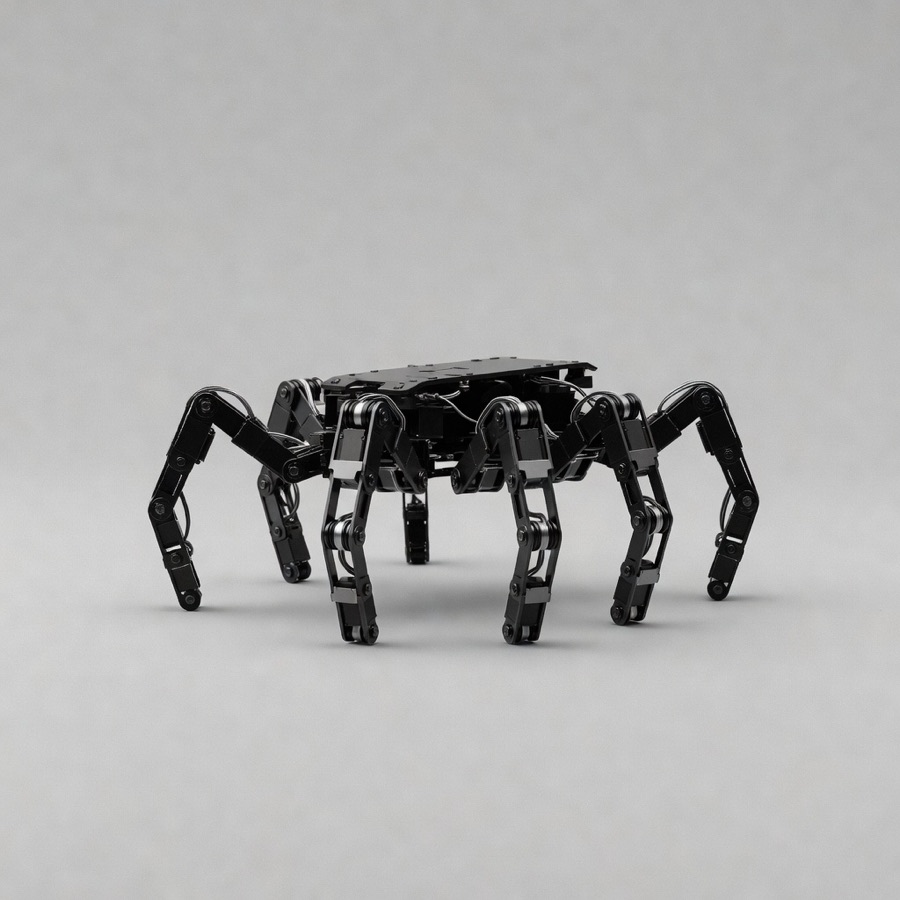
Servo is not released yet. Early access on request.
Six legs came free with the brain.
Servo closes the loop with physical actuators: joint angles in, torques out, on the Rust runtime at 1 kHz. Trained in simulation on a body model, transferred to hardware.
The connectome already drives a body: FlyGM and Eon Systems have shown walking, turning and grooming in a MuJoCo fly. Servo packages that loop for legged and wheeled platforms with a proprioception adapter for your joint encoders.
Walks in simulation. Hardware next.
Hexapod gait in MuJoCo after four hours of training on one GPU. Sim-to-real on a reference hexapod is the milestone for the first release.
target Figures marked "target" are design targets for the first release, not measurements.
Same brain, its own wiring.
Input adapters occupy afferent regions, output adapters read efferent ones. Co-processors feed in through the embedding port.
- FlyCore v0.1.0
- weights v—
- joint encoders
- IMU
- camera (optional)
- torque / position targets
- none
import flycore

brain = flycore.load("flylabs/servo")      # engine + weights + adapters
ctl = brain.attach(joints=robot.encoders, imu=robot.imu, motors=robot.motors)
ctl.run(hz=1000)
# torques streamed to robot.motorsReal motors. Real legs.
Legged robots
Hexapods and quadrupeds with a controller that was, literally, built for legs.
Camera gimbals and pan-tilt
Gaze stabilisation and target tracking, straight from the fly's head-stabilisation circuits.
- Not released. Early access on request.